11630 SW 97 Street, Miami, Florida 33176, US
 +1-786-628-7980
 Sign Up/Sign In
  11630 SW 97 Street, Miami, Florida 33176, US
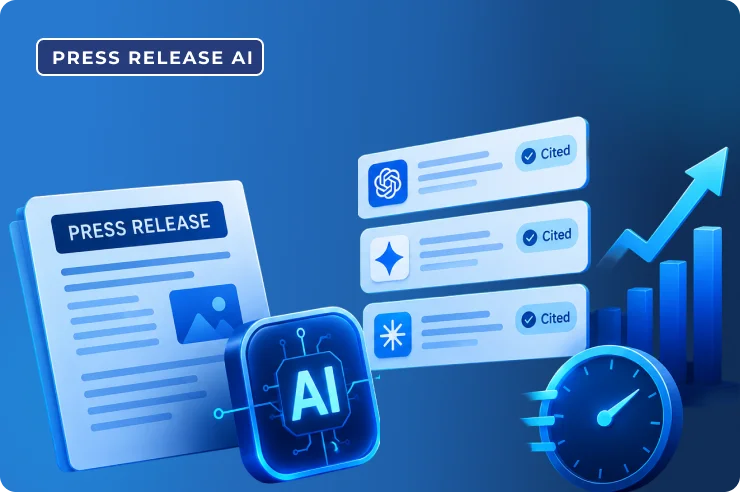
Press releases are assumed to be completed once they are sent out. After receiving the distribution confirmation, someone logs the link, and everyone proceeds to another task. Press Release AI Citations are becoming an important part of how companies measure their visibility in these AI-driven results.
People search platforms like ChatGPT and Perplexity every day for updates on company product launches. Even if you rank well on Google, missing out on AI search results means missing out on AI search visibility, which means missing out on a massive, highly engaged audience.
So, how fast does this actually happen? The industry often points to an eight-hour window, so we built this guide to break down what really happens during those first critical hours.
Eight hours is typically quoted as the average amount of time required for a release to be reflected in AI responses. It serves as a guideline and not a set rule.
The average hides the truth.
Some releases get picked up instantly, while others take days. Anyone promising a guaranteed citation window is selling something they can’t control. The only thing that is in your hands is getting the release ready.
AI models live in the present. A fresh press release enters the web without existing context, backlinks, or prior coverage. Press Release AI Citations are based partially on how easy it is for the AI systems to discover and comprehend the information. There are no links to the press release, comments, or any prior references.
If your headline is vague, crucial facts are missing, or the release lives on a single site, AI engines won’t have enough to pull from. Fixing those mistakes three days later won’t help much once the initial window passes.
That is why we consider publication to be at the center of the process, not the final part of it. Everything has to be ready before it goes online.
The release is good when there is a news-related question such as a product launch, funding, or a partnership. It is less likely that, in the case of asking the AI tool to suggest the best option in the category, the decision will be made based on just one source.
That is how you see the 8-hour window, the time when you are present in case your news is being asked about. It is good but not the solution to your problem.
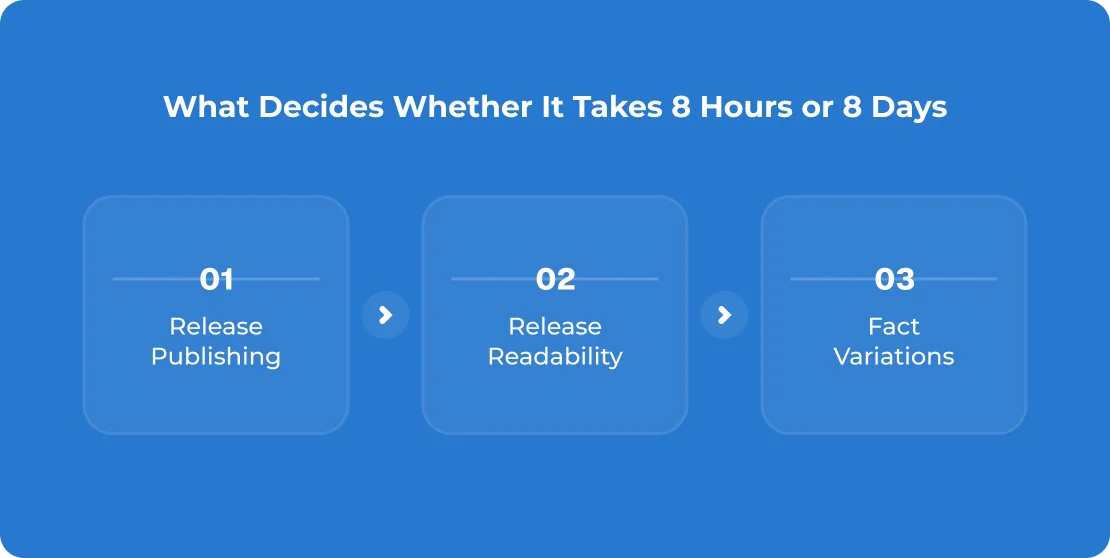
Three main factors determine this timeframe, and you control all of them:
A news release that is only found on your own site relies on a crawler randomly coming around to pick it up. A news release that is spread out across multiple sites, feeds, and channels allows the AI to have more opportunities to come across it. News releases through newswire services also provide your news release with a format.
AI technologies obtain answers from crisp writing. The algorithm is more receptive to clear headlines, concise paragraphs, and unadulterated facts than it is to flowery marketing jargon.
That means:
While writing your press release, read your first paragraph alone. Will anyone know who did what, when, and why it is important? If not, then the AI tool will find it tough too. If you want a closer look at headlines, meta descriptions, and measuring results, see our guide on how to optimize a press release for SEO.
If the same core facts pop up on many trusted websites, then the AI feels much more confident citing the facts. Press Release AI Citations occur when there is more than one trusted source where the information may be cross-referenced. It’s pretty easy to understand: the more sources the information has on its own, the more likely AI will use the information.
Here is how these criteria compare:
|
Factor |
Easier for AI tools to use |
Harder for AI tools to use |
|
Distribution |
Wire network with syndication |
Own website only |
|
Structure |
Key facts, FAQ, bullet points |
Dense paragraphs, no formatting |
|
Facts |
Specific numbers, named sources |
Vague claims, no figures |
|
Versions |
Multiple versions, republished copies |
Single version, no republishing |
While no one can guarantee an AI citation, here is how we approach the process:
In April 2025, we built AI distribution channels engineered for generative AI platforms. This tackles discovery in two main ways:
First, releases include structured metadata and schema so they can be easily parsed by AI systems. Second, the crawling activity is analyzed using analytics to verify whether the AI-based search engines actually index the information, without making any assumptions. This is offered in all our packages, among others, Paid Media Release.
To maximize reach, every release is syndicated across 9 different formats. In addition, the distribution includes RSS feeds, and Ad Boost provides distribution to premium media, hard-to-reach niche media, and popular social media channels.
Our package offers generative engine optimization, PR distribution in Amazon Alexa, distribution to the customer-provided communication list, and unlimited multimedia attachments.

The distribution includes a Master Distribution Report that you can learn more about here. Our customers can select headline guarantees between 50,000 and one million from over 3,700 websites in 26 countries and 15 industries.
These reports indicate how widely distributed your release was and how many views the headline received. Neither of these reports nor we make any claims about AI citations, and we never did. Whichever distribution service you use, please conduct your own analysis of AI citations. It will take just a few minutes.
This window favors thorough preparation over speed. This is an approach that you can take when you make your next announcement.
Write with clarity in mind. Make sure the news story is the main attraction. In the first paragraph, address the who, what, and when inquiries and include three to five verified supporting facts. Make a section called FAQS, or brief facts.
Decide if this announcement needs global reach or targeted media focus. Not all news items require wide distribution; some may need to be written in more than one language.
Send the press release simultaneously on the wire and on your own newsroom, with the same information on both platforms. If one version differs from the other by something, AI will have a reason to be skeptical of both.
Timing matters here too; following the best time to send a press release helps reach more visibility. If there is not enough time, our press release distribution experts offer rush and standard options, where we do all the formatting and uploading.
Use this window to monitor early coverage. You should ask ChatGPT, Claude, Perplexity, and Gemini the three to five questions that your buyer or investor might ask about your press release. Record your appearance there, how you are mentioned, and the source used.
Do not worry if you did not appear anywhere. Record it and check back later. If there was some kind of mistake made, either old or wrong information, you will know what needs to be fixed.
Get your story out there. Distribute the press release to trade journals and inform partners that they may cite it. Third-party reporting provides yet another source to verify your information for your AI tools. Use your crawler data, if available, to determine if AI bots have been on your site.
Repeat the same questions. News gets buried as time goes by. Therefore, you need to make your follow-up announcements instead of thinking that one press release will ensure the survival of your story forever. The regular flow of news will work better than any single announcement.
In short, the 8-hour window is about your prep time, not a speed guarantee from the distribution network. AI pays attention immediately after publication, and good structure and independent coverage increase your chances. Press release AI citations are influenced by these factors, but a press release is a way to prompt an AI response, not a full-fledged strategy.
Before making the release public, make sure that you are able to answer the following four questions: how your press release is going to be disseminated, how your release is going to be structured, how many separate versions of your story exist, and how you are going to measure the results. Once you have worked all this out, the next eight hours are negotiable.
The inclusion of the company name, heading of the press release, publication date of the press release, and the URL of the press release is very important. Another thing that must be considered is the source URL of the news release mentioned in the AI software.
Citations from AI can occasionally be useful. However, these citations aren’t always correct. An AI tool might combine data from several sources, improperly interpret data, or mention an outdated page.
There is no way to predict the time period. Sometimes, press releases will be included in AI-generated responses within hours, whereas other times, it might take even longer.
AI-powered chatbots like ChatGPT, Claude, Perplexity, and Gemini can answer a number of questions about your press release. If you are questioning investors or clients about it. Keep an eye on the AI’s inclusion of your business or press release, the sources it cites, and the accuracy of the data.


You may like these post too