11630 SW 97 Street, Miami, Florida 33176, US
 +1-786-628-7980
 Sign Up/Sign In
  11630 SW 97 Street, Miami, Florida 33176, US
The press release you issue is your own media because you created it and control the content. The only time it becomes earned media is in the event that an independent journalist, editor, or publisher decides the story merits coverage in its own way.
Consumers, as well as B2B decision makers, have created their own filter for paid advertisements. They continue to accept the authority and expertise of a respected journalist or well-known industry analyst. If a journalist has written about your business because your press release is compelling, it’s earned media.
This is the distinction between announcing that you are the most effective as opposed to a reputable expert claiming that you are the top. This guide provides an extensive 5 ways to bridge the gap between an ordinary announcement and a great media piece that dominates the conversation in your niche.
Earned media includes any mention of your company’s name that you did not buy and that you did not design yourself. Journalists write about your launch. An online reviewer reviews your service. This is by far the toughest type of coverage that you could receive, which is why it’s thought to be one of the best.
In order to understand earned media, it’s important to understand what it’s like compared to the two other types. The term owned media is used to refer to anything you manage and design, including blogs, websites, social media profiles, and press announcements. Paid media is a term that refers to the media coverage you buy, including advertisements, paid content, and wire placements, which are paid. Earned media covers all others.
The journalist who saw your story as interesting enough to write about it. The host on the podcast that invited your CEO to be an interview guest. The publication that cited your information. There was no financial cost. Instead, it was obtained through the value of the article, the quality of the notion, or the trustworthiness of the company’s brand. To get more detailed information.
Read: What is earned media, social media, and now paid media release?
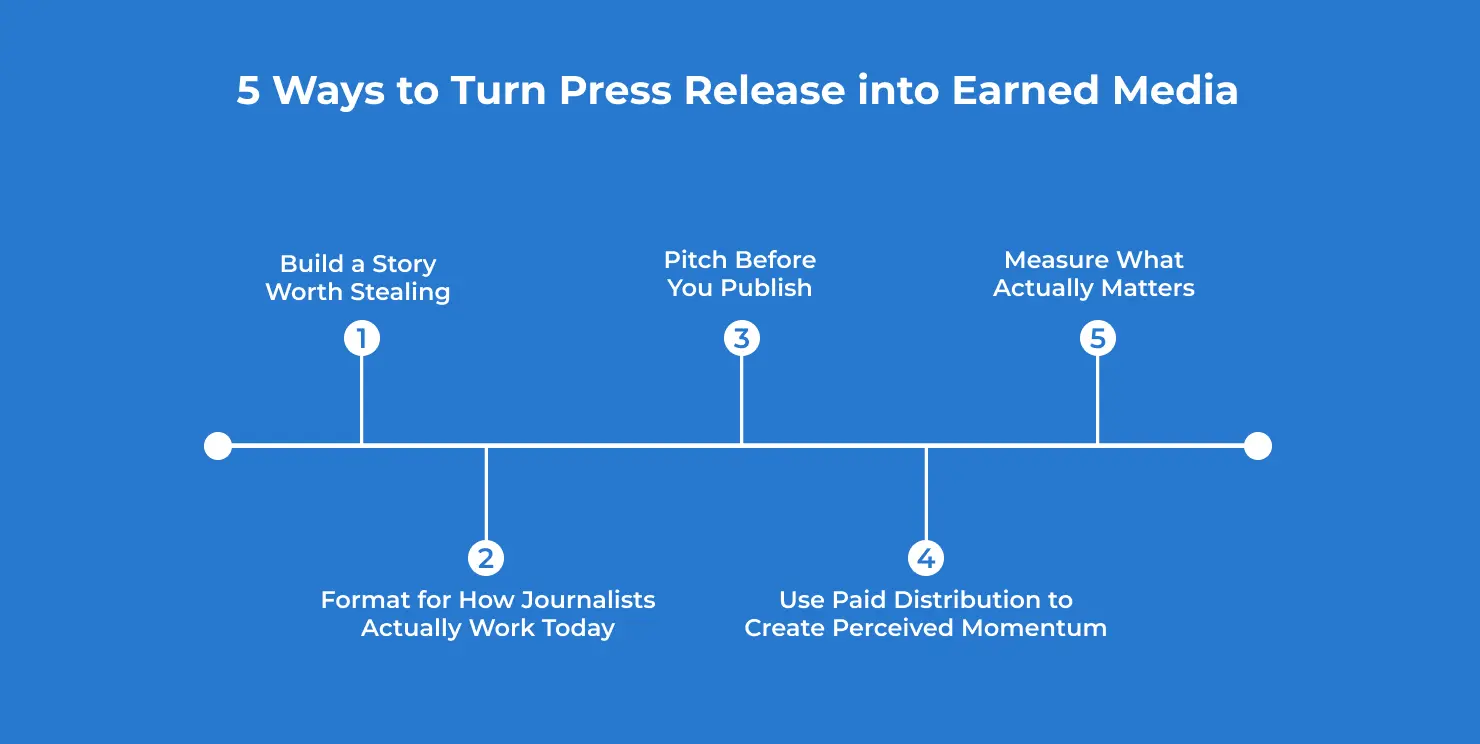
One of the main reasons that press releases do not generate earned media is the fact that they are not news; they are just announcements. Journalists do not search for information to duplicate and copy. They are searching for hooks, a tension, an unexpected twist, or a convincing fact, which will allow them to create their own narrative around.
Consider what you have changed since the announcement. Who is the beneficiary, specifically? Which problem was there before, and what do we have to offer today? Make use of the first and only test.
If you are truly the first business to offer something unique in your industry or even the only one with a particular mix of capabilities, that is a fact that should be in the headline, not hidden within paragraph 4. Follow effective ways of press release marketing to create your best stories and improve how to get media coverage.
By 2022, Salesforce had released a study that shows 88% of consumers tend to purchase companies that provide information based on data rather than promises. This same premise applies to journalists.
If your business conducted original research, such as a customer survey, the analysis of internal data, or a study of the industry’s behaviour, incorporate that information into your release. Each journalist who quotes the data you provided in their article is granted a branding mention in an authoritative publication.
Modern journalists no longer require waiting for the fax machine for an announcement about wires. They’re searching Google as well as various other engines for news, and launching queries on news aggregators and using AI tools to locate interesting reports. If your announcement is not properly formatted specifically for these platforms, it will not show up.
Traditional SEO thought was to choose a keyword, then repeat it. Focus on topical depth and follow press release distribution tips to make your press release SEO friendly. If your announcement is focused on logistics for the supply chain, you must naturally contain related phrases like inventory management, the disruption of freight, last-mile delivery, and procurement. The search engines will use these clusters to decide if your material is genuine or an unsubstantial announcement.
Google News has a specific formatting preference. They need a clear headline of fewer than 110 characters. It also needs a dateline, an organized body that includes primary information at the top and tidy HTML markup. The releases that use the inverted pyramid format, with the most crucial information first, and supporting details later.
If you own the website on which your publication is posted, add NewsArticle schema markup. The structured data will help Google to correctly classify your content and increase the chance that it will be featured as an article when journalists look up your subject. This is a 5-minute tech remedy that the majority of PR agencies overlook completely.
Wire distribution can be described as an element of the floor and not a roof. Genuinely earned media usually contain a personal outreach portion, which is in place before the public announcement.
Find 10-12 reporters who will cover your area with a depth of coverage. It’s not all of them who have spoken about your business or even mentioned it, but journalists who have a passion for the industry. Call them 3 to 5 days before the publication date. Offer some of them a special opportunity to get early access to stories.
Also, provide a chance to interview your chief executive or any proprietary information that is not going to be included in the publication. The story that journalists created themselves, as opposed to one that they created via a wire, by definition, is earned media.
An editor in a hurry is choosing among a myriad of stories. The successful stories are the ones that need minimal effort in order to create. The media kit you choose to use should contain:
Journalists will have all the materials they require to get their stories published within hours.
Journalists are more likely to report on an issue that is already believed to be popular. This is the reason why the use of strategic guidance on paid media release, when done correctly, can be a catalyst for organic coverage as a part of an earned media strategy.
Many wire distribution platforms allow you to use targeted display and social advertisements along with your announcement. Check to see that the advertisements target editors, journalists, and producers in your particular sector.
When a journalist clicks on the headline of your LinkedIn feed, is then able to see the same headline on an aggregator for news, and then receives your personal pitch note, the sequence has been made to appear as if it is everywhere. The headline feels as though it’s being told already, which decreases the barrier for journalists to cover the story.
Regional coverage is often the first step in national coverage. An announcement about technology targeted towards journalists in your region is a lot more likely to be picked up by local business offices. Understand the impact of digital media on press release distribution. The coverage that is targeted to local areas is often taken up by national media seeking authentic stories.
If your publication is producing significant click-throughs and read-time data within the first 24 hours, mention this when you follow up your pitch by mentioning generated organic views and social shares; note that, since publication, there’s clear audience interest here. Journalists are attracted by evidence of value.
A mere mention does not constitute an award. Any mention that leads to qualified leads is an accomplishment. The key difference lies in the method you monitor.
Every link you include in your press release needs to have the distinctive UTM parameter. If a post on an industry-specific trade website results in zero conversions, you should eliminate this avenue.
Volume of coverage can be a vanity measurement. The most important thing is that coverage presents your brand’s image positively or reaches the customers in your target market, and if the tone of voice matches your branding. One well-timed article on The Harvard Business Review is worth more than forty positive mentions on low-authority aggregators.
Brands that produce consistent earned media do not view every release as an individual occasion. They look at which angles brought about media coverage, which data sources were most cited, or which journalists were with the most. Then utilize that data to help shape the next piece. PR is more iterative than periodic.
In short, each time one of these steps is working together, a change occurs. Paid distribution provides the initial exposure. The visibility of the story reaches reporters who believe the story is trustworthy and relevant. The independent reporting (earned media) can drive traffic to your own channels. The traffic generates leads, cases, and new information. This data is the basis for your next publication.
This is not a method or a tactic. It’s a process and a process. The companies that create it and that view every news release as the beginning of an ongoing cycle in the media rather than the end of the line of a communication initiative will be the ones to control the conversations in their field over the long term.

No, a press release itself is considered owned media because you control the content. The only way to earn media is if a journalist discovers that it is intriguing enough to write their own story on your company. Consider the press announcement as a pitch and the resulting report as the earned reward.
Yes, PR is often incorporated into paid-for media when you use distribution wires in order to ensure that the publication of your story on certain sites. Contemporary PR can also include sponsored content, which is when you purchase an article that is professionally designed to appear like a news report. When you do this, you pay for reach, not just waiting for the reporter to find you.
The primary difference lies in control over credibility. You are charged for complete control of your image in paid media. Earned media is not expensive, and you can not influence what journalists say about your business.
Legally, you hold the copyright for the exact phrases you composed at the time you created the document. In distributing your press release, you basically grant the media permission to make use of your information or quotes in order to promote your information.

You may like these post too