11630 SW 97 Street, Miami, Florida 33176, US
 +1-786-628-7980
 Sign Up/Sign In
  11630 SW 97 Street, Miami, Florida 33176, US
AI press release distribution has fundamentally shifted from a media-volume-based model to a more intelligent discovery system. Traditional PR-related frameworks are still focused on syndication networks. These metrics are increasingly a reflection of the mere automation of an activity, and not real, quantifiable effects on markets.
Press releases are today absorbed, processed, and interpreted by sophisticated artificial intelligence platforms, such as answer engines, semantic search algorithms, and large-scale generation platforms. The algorithmic gatekeepers decide whether the material has authenticity of the structure as well as the contextual significance that is worth sharing with end-users.
We have compiled this guide with 7 ways how AI is reshaping press release distribution and implementing an AI-driven PR strategy to help your business improve visibility, engagement, and the overall impact of its PR campaigns.
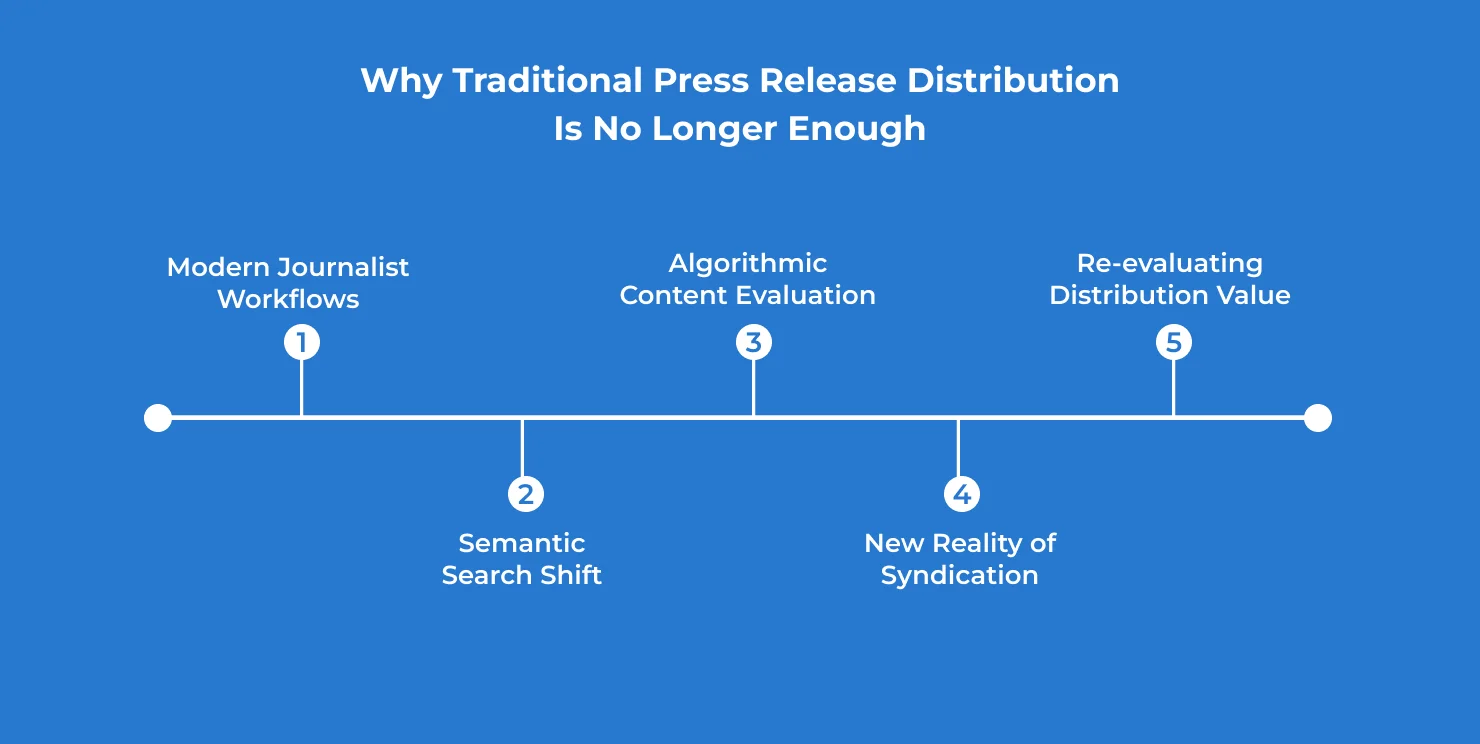
The traditional press release strategy was easy and predictable. It was to execute massive wire syndication, stuffing your copy with targeted keywords, blasting static media lists, and count on a single publication surge.
The following are the areas in which AI press release distribution is changing the PR model.
Modern AI technology does not just look up keywords in text and trace the digital things by identifying entities through entity-based search in public relations. Modern algorithms recognize the definition, categorize, and classify distinct entities, specific corporate executives, exclusive products, niche industries, historic events, and geographical areas to examine the web of relationships among them to assess their contextual importance.
Modern press release distribution platforms specifically clarify who is involved, the type of innovation taking place, and how it alters the business scene. This allows AI to quickly map the information into global knowledge graphs.
SEO or Search Engine Optimization (SEO) is no longer the sole or the primary search gatekeeper. By 2026, an announcement will be required to actively generate engine optimization for PR in the context of conversational AI models. Along with populating the real-time summary of answer engines, and ensuring high-visibility space inside the search-engine-based AI overviews.
This will require a break from traditional optimization strategies. GEO demands:
PR professionals need to learn to write to two different audiences at the same time and simultaneously. Explore how to get your press release cited by ChatGPT and Perplexity. The human journalist who is looking for a story hook, and the more analytical algorithm that extracts the most important data.
Generative AI platforms are a great choice for content that they can consume and understand with no structural confusion. Modern press releases have structured newsrooms, including lean HTML, standard schema markup, logical narrative flow, and precise metadata for each press release that helps web crawlers to categorize the release accurately.
An overly-textualized, text-heavy publication full of corporate jargon and ambiguous cross-references will not simply irritate humans, but it also punishes the content. Through top Ad boost channels, your content is formatted with precise schema for clean ingestion by OpenAI, Perplexity, Anthropic, Apple, and ByteDance.
Media spreadsheets that are outdated and static were replaced by intelligent, dynamic modern media targeting algorithms. The latest platforms constantly analyze journalists’ behavior, their rolling history of coverage, shifting trends in the media, and trends in social engagement.
Instead of sending a generic release to 500 blind media contacts, use targeted media distribution for your business to analyze journalist coverage history, shift trends, and social engagement to identify the exact group mathematically primed to pick up your story.
The introduction of pre-distribution AI press release optimization techniques has transformed PR into a proactive field. Modern interfaces analyze a story before it goes to the web by analyzing headline click-through possibilities, checking structural alignment in relation to changing SEO or GEO algorithms.
Such an AI system identifies inconsistencies, as well as highlighting the absence of supporting facts. Create your story and optimize your press release following SEO best practices. This represents a major departure from the previous method, where optimization was either a last-minute decision or a non-measured parameter.
Press releases traditionally rely on a retroactive lag. Teams of communication would have to wait for days or even weeks to receive manual clippings and basic sheets for syndication and vague web-based hits.
AI-enabled distribution platforms provide deep, immediate performance diagnostics. Such as live-streamed visibility monitoring across all search layers, instantly automated sentiment analysis of the social networks, GGP mapping, and the predictive channel scoring system to measure current campaign performance and ROI.
Press releases must be able to be analyzed and interpreted by all of the available AI search engines or voice assistants, personal productivity assistants, and the corporate knowledge graph.
If the AI crawler can not effectively interpret, categorize, and validate your company announcement, it’s likely to disappear when a person enters a very specific query for business. It results in a lost mention, a lost impression, and an unrealized chance to shape the narrative of the market.

We keep our distribution system updated to align with the market trends and changing search algorithms. Our team focuses on AI press release distribution to get press releases optimized for AI platforms and search engines.
The PR team uses traditional ways to prove their worth, using their clipping file or a spreadsheet that shows 500 syndication picks. Nowadays, the majority of these automated picks are on ghost websites that are never seen by anyone. Beyond this, it is important to track parameters that impact the bottom line:
The public and journalists are increasingly getting their news through an AI answering engine (like ChatGPT, Perplexity, or Google Gemini) rather than normal search results. To become AI-ready, your press releases should be able to be read through Large Language Models (LLMs):
The days of mailing an email to a predetermined list of journalists with 10,000 names have come to an end. Modern PR technology uses machine learning to help you find those who are interested in your message:
The purpose of a press release isn’t to be a one-time, isolated announcement. It should be used for a wider strategic objective. If it is considered an investment, the news release helps:
Press release is not a set it and forget it business. Since technology and the media landscape are constantly changing, PR teams need to consider campaigns as ongoing research projects:
In short, AI press release distribution has changed because now, AI search bots control what company news is made available before human viewers or traditional journalists have the chance to encounter the information. In the present, lasting image visibility for your brand is less dependent on the volume and quality of your distribution system and more on the clarity of your structure, as well as the fact-rich and machine-readable press release that appears upon consumption.
Focus on transparency of the entities, ability to cite facts along with flawless formatting, as well as native AI discovery, will always surpass competitors who rely on outdated techniques of brute-force syndication. Nowadays, the most effective companies use press releases as a direct link to prospective customers.
Look for the companies that combine AI-powered targeting with improved visibility and discoverability driven by performance strategies, and provide organizations improve their reach, effectiveness, and value over the course of their marketing.
No. PR is not going to be completely replaced by AI. However, operational functions could be reduced. AI misses personal decision-making sensitive insight. Emergency interaction and tactical advice require compassion, moral and traditional distinction; these traits cannot be replaced by AI.
AI is presently automating press tracking, perception assessment, and publicity recording. It helps units to monitor company references instantly throughout countless channels. PR professionals now invest less time in manual information compilation and more in planning.
AI will transform PR by predicting image-related threats before customizing proposals for individual journalists based on their previous reporting patterns. The latest AI tools will also help PR ability, as will auditing AI-generated material for accurate mistakes.
No. Journalism is not being replaced but will be enhanced by which particular sectors are at vulnerable threat. AI is ruling in data-driven, structured reports, which some newsrooms have already digitized. However, investigative journalism, direct discussions, and publishing evaluation and narrative content creation continue to be manually directed.

You may like these post too