11630 SW 97 Street, Miami, Florida 33176, US
 +1-786-628-7980
 Sign Up/Sign In
  11630 SW 97 Street, Miami, Florida 33176, US
Paid press release promotion is often the next step when standard distribution fails to deliver the visibility and engagement that communications leaders and founders need. If you are considering Ad Boost, you likely have already noticed that standard distribution wires alone do not always meet engagement and visibility requirements.
Ad Boost is not an upgrade to standard distribution; instead, it is an amplification strategy. A compelling story supported by Ad Boost reaches the right audience and transforms opportunities into pipeline.
A weak story is unlikely to perform better simply because it is placed in front of a larger, more expensive audience. When PR campaigns underperform, the problem is often not the paid distribution itself but a mismatch between the announcement, audience, timing, and campaign objectives.
We have compiled this guide to provide a framework for determining when Ad Boost is worth the investment.
Ad Boost layers paid media on top of release distribution, such as Google Ads targeting, social ads, and placements in publications relevant to your industry. The majority of packages guarantee thresholds for headline views along with demographic targeting and custom ad creative, rather than a static listing on a wire.
Instead of placing your release on distribution wires and waiting for the audience to find it, Ad Boost pushes it directly into the feeds and search results of the people you’re trying to reach.
Organic distribution is passive and unpredictable. Paid amplification has greater control over your promoted announcement. If you choose the wrong vertical for your business and the wrong platform mix or inappropriate location, you may waste your funds without reaching a true decision-maker.
Ad Boost can not create a compelling story for a weak one, sharpen a generic CTA, or generate interest among the audience. Announcements and ads have different functions; this is why people have different levels of trust in the two.
Traditional press release distribution relies on metrics that do not result in pipelines. A feed push places your news headline on a multitude of subdomains, including mirrors for local media and financial tickers. They also have archives of unread corporate websites. They are technically up and running, but nearly none of them are read.
The distribution report based on traffic to the domain can give you a stunning impressions estimate, which has nothing in common with actual readability or even engagement. This gap gives an illusion of safety. Top-line figures appear good, but the traffic from referrals within Google Analytics stays flat, and leads from inbound sources do not show up.
Paid amplification takes advantage of archives that are passive by using an active inventory of advertising instead. Instead of leaving your headline within the RSS feed, this converts your announcement into banners for display, sponsored feed posts, and native ads.
Want More than a Number on a Distribution Report?
Sign up to Get Your News Seen Beyond the Wire
Paid amplification avoids archives of passive associations by making use of active advertising inventory. Instead of leaving your message buried in your RSS feed, this transforms the headline from your press release into display banners, posts from sponsored feeds, and native network placements.
Instead of paying for inactive availability for websites that no one visits, you can purchase the right to display your announcement in front of the most active users.
Enterprise and growth-stage brands must justify every dollar spent on press release promotion. Treating press release distribution as a fixed annual expense can lead to inefficient budget allocation. Communications budgets can be managed more effectively by allocating spend according to the potential value of each announcement, similar to how a properly planned press release marketing strategy considers every channel an investment.
Think about the basic costs of creating and publishing a typical release. This includes drafting time, executive sign-offs, legal review, and wire distribution charges. If the investment is high for each publication, the fact that you publish an announcement without generating goal engagement is a sign that the baseline capital is wasted.
Ad boosts increase advertising spend. However, for announcements with high signal levels, that boost increases the ROI of your initial expenditure. This is the goal of not diffusing paid amplification across each and every update. Instead, focus on operational updates that are low impact, putting your funds on high-value announcements to generate high return.
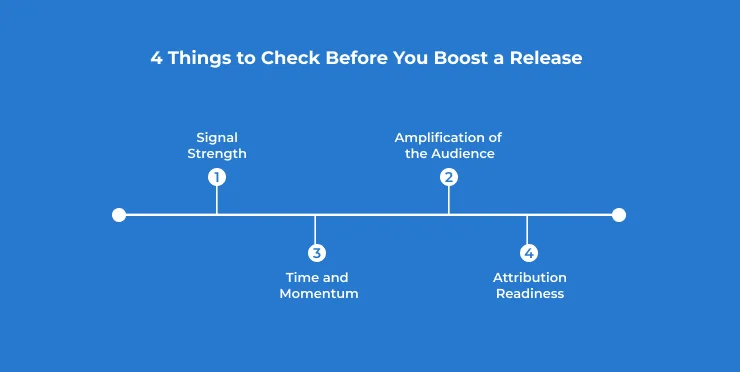
You can follow these four guidelines before assigning budgets to an announcement. If an announcement does not meet at least two of them, you can put aside the money for the following one.
People are only interested in information that affects either them or their market. For instance, significant partnerships, major funds, or new product launches. Anniversaries of the company or minor tweaks to websites can be exciting for the team and are not interesting for people outside. If news is dull, buying advertisements is just a way to display uninteresting content on screens. Ads may increase the visibility of a story, but they can not force viewers to pay attention.
If you are able to identify specific jobs, sectors, or media segments that your customers read, then targeting can generate real returns. If your audience is merely founders or business leaders, you are paying a premium for an audience that is too wide to be converted.
A news announcement about funding that is boosted in the morning of its closing creates momentum, whereas a similar announcement that was boosted just three weeks after will be neglected. The boost is triggered by immediate events like launches, increases, earnings, and important conferences.
With no UTM-tagged URL and specific goals for your conversion-oriented landing page, you are paying for unmeasured clicks. Understand measures of success before launching your ad, like CTR, website conversions, or even direct contact with the site.
You should review your conversion strategy before launching to get more value from your campaign. When you drive paid traffic to an announcement without proper tracking, this results in an attribution gap and makes it impossible to measure your actual ROI.
Paid amplification is more than an immediate traffic-driving factor. This plays an important part in developing long-term credibility and relevance to the topic. To maximize long-term search impact, structure your press release with SEO best practices before enabling paid amplification.
Search engines today evaluate brands’ credibility by looking at live audience engagement indicators such as brand citations across the most authoritative media. Reader traffic and referral citations strengthen your site’s presence in the market.
A boosted announcement should not be viewed as an independent announcement. Instead, you should consider structured announcements as part of larger clusters of content:
The integrated strategy links spending on PR directly with long-term organic search results and also to the credibility of the brand through PR amplification.
Before spending on an amplification package, confirm all five:
If your announcement clears all five of them, Ad Boost is worth the expense. If you miss one or more of them, stay with the standard distribution model and put your attention on the upcoming big-signal announcement.
If your announcement meets the signal strength criteria, iCrowdNewswire Ad Boost turns your release into an active media campaign.
In short, the main issue with the press release promotion is usually not how much to invest in advertisements, but rather whether it is compelling enough to attract a larger public’s attention in the first impression.
It is easy to think that boosting the process is a fix for a product that’s not getting traction, similar to sending paid traffic to an unresponsive landing page. Expecting it to turn into a sale. Both cases show that the distribution spending won’t resolve the issue that lies at the heart of the main offering.
The firms that are earning the best returns from Ad Boost pull the lever carefully on releases that provide strong market signals. And they do not hesitate to skip the boost if a release fails to pass the bar.
Have a big announcement coming up?
Set your budget depending upon your business size, target audienec an niche. The pricing tier is different for startups, niche businesses, growing businesses, national brands, and large enterprises.
Yes, boosting a post is worth it if your principal goal is fast and low-cost engagement, brand awareness, and generating immediate exposure to a particular change. But it is not a good idea for complicated lead generation or conversions because standard posts do not have sophisticated targeting capabilities and retargeting features.
An ad boost is worth it for press release promotion if you have an important announcement that resonates with your target audience and you want to increase exposure locally or to build social trust. It is especially useful if it is targeted at specific geographical locations or people who already have an interest in the news of your company.
Paid press release promotion provides guaranteed results across online news outlets, improving authority, and increasing the chances of media pickups.

You may like these post too