 11630 SW 97 Street, Miami, Florida 33176, US
 +1-786-628-7980
 Sign Up/Sign In
  11630 SW 97 Street, Miami, Florida 33176, US
The Comprehensive Transformation of the Global Smart Building Market
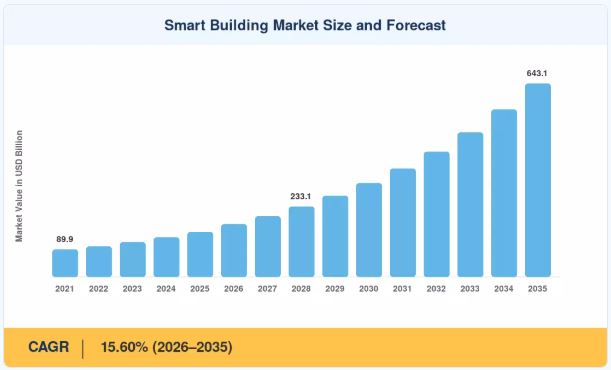
The global Smart Building Market is undergoing a profound structural evolution, shifting from a collection of isolated operational technologies into a fully integrated, hyper-connected digital ecosystem. Valued significantly in the hundreds of billions of dollars, the market is projected to witness explosive growth through the late 2020s and early 2030s, fueled by a high compound annual growth rate (CAGR). This growth trajectory is propelled by macro factors: structural global urbanization, escalating real estate operation costs, stringent government net-zero carbon mandates, and the widespread commercial viability of Internet of Things (IoT) sensors and Artificial Intelligence (AI).
The global Smart Building Market was valued at USD 149.20 billion in 2025, driven by the rapid adoption of intelligent building technologies and growing worldwide initiatives focused on decarbonization and energy efficiency. The market is projected to expand from USD 174.40 billion in 2026 to USD 643.10 billion by 2035, reflecting strong long-term growth as governments, businesses, and property developers increasingly invest in connected infrastructure, automated building management systems, and sustainable construction practices.
Historically, commercial real estate treated heating, ventilation, air conditioning (HVAC), lighting, electrical grids, and security platforms as distinct, siloed physical assets. Today, the convergence of edge computing, cloud analytics, and unified communication protocols has made data-driven orchestration the standard for modern facility management. Smart buildings are defined not just by automation, but by their capacity to listen, learn, and dynamically adjust to human behavior and external grid demands in real time.
Request To Free Sample of This Strategic Report
https://www.marketresearchfuture.com/sample_request/1860
Market Dynamics: Drivers, Restraints, and Technical Opportunities
Market Drivers: The Core Impetus
The primary catalyst behind the smart building surge is the urgent global demand for energy efficiency and sustainability. Statistics from the United Nations Environment Programme indicate that the built environment accounts for roughly 40% of global primary energy consumption and approximately one-third of global greenhouse gas emissions. With direct and indirect building emissions rebounding post-pandemic, corporate entities face heavy regulatory penalties and strict ESG compliance demands. Intelligent Building Energy Management Systems (BEMS) allow organizations to reduce energy waste significantly, establishing a clear, high-yielding return on investment (ROI) that attracts institutional property developers.
Furthermore, government backing acts as a powerful market accelerator. Programs like the European Commission’s “Fit for 55” initiative and global green building certifications (such as LEED and BREEAM) provide financial incentives and regulatory frameworks that compel property owners to retrofit outdated assets with intelligent automation.
Restraints and Challenges
Despite clear economic benefits, the market faces two persistent friction points: high initial capital expenditure (CapEx) and cybersecurity vulnerabilities. Retrofitting decades-old structures requires extensive sensor installation, network rewiring, and specialized software customization, which can deter small-to-medium enterprise (SME) property owners. Additionally, the expansion of interconnected IoT devices expands the digital attack surface of a building. A vulnerability in a minor device can expose the entire corporate intranet, allowing threat actors to manipulate physical systems or compromise sensitive corporate data.
Technical Opportunities: Building-to-Grid Integration
The next frontier of growth lies in the seamless integration of buildings with smart electrical grids. Through bidirectional communication, a smart building can function as a flexible node on the energy grid—reducing its load automatically during peak hours or drawing power from its on-site battery storage arrays. Powered by AI predictive analytics, this structural interplay mitigates stress on national energy infrastructures while unlocking dynamic energy-arbitrage savings for building operators.
Expanding Frontiers: Core Use Cases and Targeted Sub-Segments
The smart building paradigm extends beyond standard commercial offices, deeply embedding itself into industrial, public, agricultural, and specialized urban ecosystems:
Representing the industrial arm of the market, the Smart Factory integrates industrial automation with building management system (BMS) architectures. Here, facility controls directly interface with manufacturing execution systems (MES). If production line sensors detect an operational anomaly or temperature spike in heavy machinery, the building’s ventilation system automatically adjusts to dissipate heat, preventing unplanned downtime. Industrial facility platforms use edge computing to process telemetry data locally, balancing employee safety, environmental compliance, and asset longevity.
As the vital sensory endpoint for climate control, the modern Smart Thermostat has advanced beyond simple programming schedules. Utilizing deep learning algorithms and occupancy sensors, these devices study the thermal dynamics of a room alongside historical occupant behavior. By factoring in external weather changes and real-time utility pricing data, smart thermostats modulate HVAC outputs preemptively. When scaled across multi-tenant high-rises, this precision dramatically lowers baseline operational costs.
Smart landscaping is vital for sustainable property design, and Smart Irrigation technologies handle this by managing external water consumption. Rather than relying on rigid, pre-timed watering schedules, these systems tap into localized IoT soil moisture sensors and real-time meteorological data feeds. Water is distributed only when required, preventing over-saturation and preserving municipal water resources—a critical factor for buildings aiming for comprehensive net-zero water certifications.
Smart buildings do not exist in a vacuum; they serve as the micro-components that construct a Smart City. Municipalities leverage open data standards to link corporate, residential, and public buildings directly into city-wide transit, waste, and emergency network infrastructures. For example, during public safety emergencies, a smart city core can pull occupancy metrics directly from local buildings to optimize emergency medical routes and resource allocation, developing a highly resilient urban landscape.
Operating at the intersection of public safety and grid efficiency, Smart Street Lights form the hardware backbone of outdoor urban networks. Modern installations go beyond energy-saving LEDs; they double as structural chassis for environmental telemetry sensors, Wi-Fi hotspots, EV charging points, and traffic cameras. When connected to centralized management software, they dim during low-traffic hours and brighten instantly when pedestrian motion is detected, cutting municipal electricity costs.
Buy Now Premium Research Report
https://www.marketresearchfuture.com/checkout?currency=one_user-USD&report_id=1860
Large public venues present unique operational challenges, which Smart Stadium architectures address through massive IoT connectivity. These spaces deploy real-time crowd analytics and automated entry systems to manage tens of thousands of visitors efficiently. Digital twin software monitors high-density traffic flow, dynamically adjusting zone ventilation, rerouting stadium concessions, and scaling waste disposal utilities to keep guest comfort high and resource waste low.
The modern Smart Workplace uses space optimization and employee well-being as core metrics for corporate real estate value. Utilizing under-desk sensors and spatial cameras, workplace analytics engines track real-time occupancy patterns. This data helps organizations reconfigure desk layouts, automate meeting room check-ins, and dynamically power down empty zones, directly boosting employee productivity and workspace utilization efficiency.
Human-centric design is central to Smart Wellness initiatives. These systems coordinate indoor air quality (IAQ) monitoring, circadian LED lighting, and acoustic dampening tools. If carbon dioxide (CO2?) levels rise in a space, the BMS increases fresh air intake to prevent fatigue. By adjusting indoor spaces to human biological rhythms, wellness technologies lower absenteeism and enhance workforce cognitive performance.
In medical facilities, operational failures carry severe risks, making Smart Hospital infrastructure indispensable. These setups feature asset-tracking tags for life-saving gear, automated environmental controls for surgical suites, and isolated ventilation zones for infection containment. By syncing clinical workflows with building operations, smart hospitals secure continuous backup power and maintain strict regulatory compliance.
Often overlooked, the Smart Bathroom plays a vital role in facility hygiene and asset preservation. Touchless, sensor-driven fixtures track real-time water flow rates, automatically flagging concealed leaks or blockages. In tandem, occupancy counters alert facility teams to dispatch maintenance based on actual usage rather than rigid timetables, reducing supply waste and keeping sanitation standards high.
Browse In-depth Market Research Report
https://www.marketresearchfuture.com/reports/smart-building-market-1860
Companies Profiled: Institutional Pillars of Innovation
The market is led by technology providers, industrial manufacturing conglomerates, and enterprise computing companies delivering end-to-end hardware and software suites:
Siemens: A dominant force in building automation, its Desigo CC platform and digital twin applications allow complete integration of fire safety, power distribution, and climate controls into unified dashboard environments.
Honeywell: Specializes in comprehensive occupant safety and indoor air quality solutions, deploying cloud-connected Forge predictive analytics platforms to optimize enterprise asset performance and reduce building carbon footprints.
Johnson Controls: Globally renowned for its OpenBlue suite, the company focuses on delivering connected, sustainable architectural ecosystems driven by AI-powered energy conservation tools and advanced HVAC equipment.
Schneider Electric: A market leader in digital energy management, its EcoStruxure framework offers scalable IoT architectures that link microgrids, electrical distribution, and facility systems to ensure operational efficiency.
ABB: Known for intelligent building controls and electrical installation tech, its i-bus® KNX system provides reliable, decentralized lighting, shutter, and climate automation across residential and commercial markets.
Cisco: The fundamental network foundation provider for smart buildings, utilizing Power over Ethernet (PoE) switches and secure wireless access architectures to link billions of IoT sensors safely.
IBM: Focuses on data analytics and asset management via its Maximo application suite, transforming complex building telemetry data into actionable maintenance strategies and long-term space utilization insights.
Carrier Global: A major innovator in advanced HVAC solutions, it incorporates smart connectivity features directly into large-scale commercial air management hardware to enhance indoor environmental quality.
Legrand: Specializes in building electrical infrastructures and digital networks, providing smart lighting systems, data center cable management, and user-friendly architectural user interfaces.
Robert Bosch: A prominent player in industrial automation and physical security, offering high-definition IoT surveillance, fire detection systems, and energy-monitoring services tailored for modern smart cities.
Conclusion: The Automated Horizon
The global Smart Building Market represents a permanent paradigm shift in how humanity interacts with physical structures. By unifying individual systems like smart thermostats and modern workplace tools with heavy industrial environments like smart factories, the built environment is evolving into an active partner in environmental sustainability. As AI, edge computing, and smart city architectures mature, buildings will move completely toward self-optimizing, autonomous operations—reducing worldwide carbon output, lowering corporate costs, and fostering healthier environments for future generations.
Explore More Market Research Future Reports:
Smart Factory Market
https://www.marketresearchfuture.com/reports/smart-factory-market-2317
Smart Thermostat Market
https://www.marketresearchfuture.com/reports/smart-thermostat-market-2521
Smart Irrigation Market
https://www.marketresearchfuture.com/reports/smart-irrigation-market-2529
Smart City Market
https://www.marketresearchfuture.com/reports/smart-city-market-2624
Smart Stadium Market
https://www.marketresearchfuture.com/reports/smart-stadium-market-2673
Smart Workplace Market
https://www.marketresearchfuture.com/reports/smart-workplace-market-4465
Smart Wellness Market
https://www.marketresearchfuture.com/reports/smart-wellness-market-4484
Smart Hospital Market
https://www.marketresearchfuture.com/reports/smart-hospital-market-4505
Smart Bathroom Market
https://www.marketresearchfuture.com/reports/smart-bathroom-market-4841
Smart Street Lights Market
https://www.marketresearchfuture.com/reports/smart-street-lights-market-5966
Disclaimer: The iCrowdNewswire provides distribution services for Research Marketing reports, however, it does not assume any responsibility for the content (facts, opinions, photos, or any other part of it) of the reports. All responsibility of the content is with the publisher of the report.
